1185 words, a 5 to 8 minute read
After mid-1933 the country, the county and Mount Vernon rose from the Depression through the pre-war and post-war booms. Elden D Pollock built a small theater empire in the North Sound, culminating in opening the first Drive In theater north of Everett.
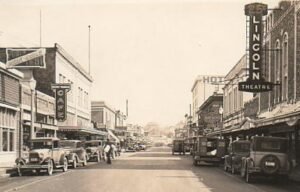
This act in the history of the Lincoln begins with the theater reopened by the Pollock family on April 29, 1933, a week after the previous owner, Waldo Ives, turned over his keys. Ives moved immediately to reopen the Mission (Lyric as of 1953). Elden W Pollock, the Lincoln owner, tapped his son Elden D Pollock to manage the family interests in the theater. Elden D, an MIT trained engineer living in Seattle managed a flying service in Bothell. He hired a manager to run the Lincoln for the family rather than find another person or firm to lease the theater.
Waldo Ives kept the Mission (Lyric as of 1953) open until he reopened the Paramount (Lido as of 1953) as the Roxy and began a price war with the Lincoln. Premium prices at the Lincoln fell to 25¢ to meet Ives’ new Roxy price of 15¢. Both theaters began began booking low cost live acts. By the end of May the Lincoln had a local vaudeville show and the Roxy launched a talent contest.
By August 1933 both theaters were charging 25¢ for adults. The Roxy was showing racier, more ‘adult’ films than the Lincoln. By the end of 1933 the Lincoln hosted afternoon cooking classes that drew 900 to two sessions, local plays, and a film about Henry Ford offered free courtesy of a local car dealership. In 1935 the cooking school at the Lincoln was cosponsored by Puget Power.
By 1935 Elden D Pollock had moved to Mount Vernon. As a member of the Air Corps Reserve he took part in the first military aircraft takeoffs from the dirt runways of the Bay View airport, now Skagit Regional Airport. Elden D. met a plane at the airport which ferried him south to meet his reserve commitments.
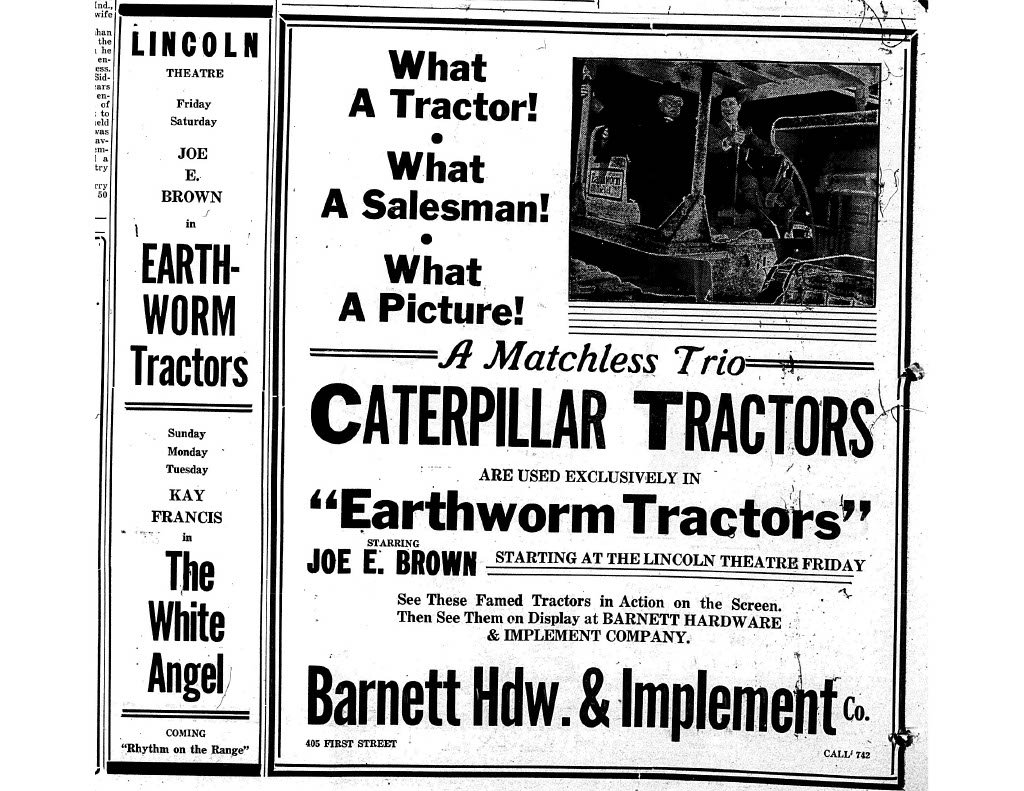
An entire feature film with a Caterpillar tractor as a major character was shown in 1936 at the Lincoln with a supporting ad from the local implement dealer.Other support for downtown Mount Vernon merchants included free showings of movies at the Lincoln and Roxy from 2 to 5 while parents attended a downtown-wide two and half day “Spring Opening” event with fashion, machinery and auto shows at various merchants.
As the economy recovered from the Depression the Mission theater (Lyric as of 1953) reopened in June 1937 with a 15¢ price for two features – refurbished and with new, state of the art RCA sound. The Lincoln touted new seats with cushioned backs and current releases featuring big stars versus the Mission’s (Lyric as of 1953) two to 5 year old rereleases or current Westerns.
In October 1937 Waldo Ives brought “Gambling with Souls” to the Roxy as a midweek adults only film, setting off a controversy which reached the Mount Vernon City Council. The film was touted as an expose of vice rackets with a plot of mobsters cheating young women at rigged gambling games forcing them into prostitution to pay off their debts.
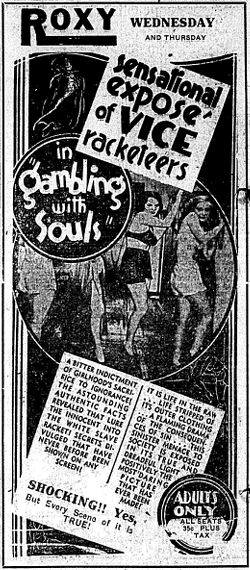
The council heard a report from an ad hoc, mayor-appointed group of film attendees. Four of the 5 members of the group thought such movies should not be shown in Mount Vernon. The Council formed a committee to draft a movie censorship ordinance. When the committee reported back to the council two months later, in December 1937, action on their proposed ordinance was tabled because the proposed censorship board was deemed “too powerful.” There were no further reports of the proposed ordinance. The Pollocks, Eldon W and Eldon D, announced they had assumed the lease of the Roxy and would operate it after the first of 1938 as the Lyric (Lido as of 1953) with all new equipment. It would be a medium priced show house operated in conjunction with the Lincoln.
The Mission (Lyric as of 1953) leapt into the void and announced they would begin showing first run films at increased prices. That attempt to move upmarket did not last long and soon the Mission was reduced to 3rd place in the hierarchy of Mount Vernon theaters when the Lyric (Lido as of 1953) reopened in April 1938.
The 3 theaters and the businesses in Mount Vernon continued to support each other indirectly by drawing Skagit residents to downtown. Sometimes the support was direct as with the fashion shows and free matinees already mentioned. This symbiotic relationship helped make the Mount Vernon downtown the commercial hub of Skagit County, as the Mount Vernon Argus reported in an article of March 11. 1938.
…Approximately 4,200 people reside within the corporation limits of Mount Vernon, which is only a little more than a mile square in size. The business district however is comparable to that of a city of 16,000 for that is the number of people in the Mount Vernon trading area…
Mount Vernon has 172 retail stores. Federal figures show that in 1933, the per capita retail sales here amounted to $1,016.53, the second highest in the entire state…
The power of the Pollock theaters to get the best films was demonstrated in 1940 when “Gone with the Wind” played for a week at the Lyric (Lido as of 1953) at advanced prices two months after opening in Seattle and and 11 months before it was shown in Anacortes or elsewhere in the county in 1941.
By 1943, the Mission (Lyric as of 1953), which had been closed and open intermittently since 1938 reopened with Elden D Pollock as the operator, giving the Pollocks control of all three theaters in town. By this time Elden D was a fixture in Mount Vernon politics as chair of the city Planning Commission. He worked with students and a squadron of air scouts to encourage and support their interest in flying.
In a series of articles in 1948 the Mount Vernon Argus noted the sway that the Pollocks and their manager Eddie Snow held over film distribution in Skagit County.
…[Eddie] Snow is the handy man around the small chain of theatres in Mount Vernon. He picks the pictures, generally. Each Tuesday he treks to Seattle..and bills the best [film] that is available…[i]n addition to the three Mount Vernon houses…he also books pictures for the two Anacortes theatres…[and] the Bothell theatre, owned also by Pollock…
By 1949 Elden D Pollock had added partial ownership of Snohomish theater and announced plans to build a drive-in just south of Burlington. The Skagit Drive-In opened August 16, 1951 in the area now occupied by the Burlington Target. The drive-in was operated until the early 1980’s when the site was sold to the Burlington Mall developer.
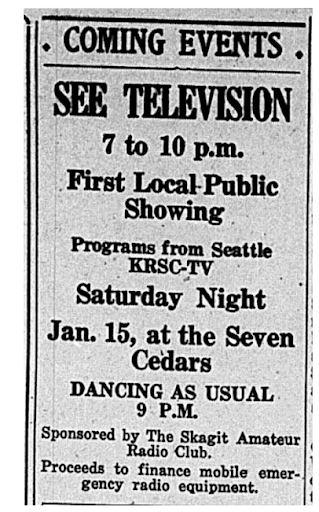
However, also in 1949 ads began appearing for the first demonstrations of television in Mount Vernon. Equally as foreshadowing is that the site of the demonstration was the Seven Cedars was a dance hall at what is now the site of the Mount Vernon Safeway. The locus of development and commerce was beginning to shift out of downtown.